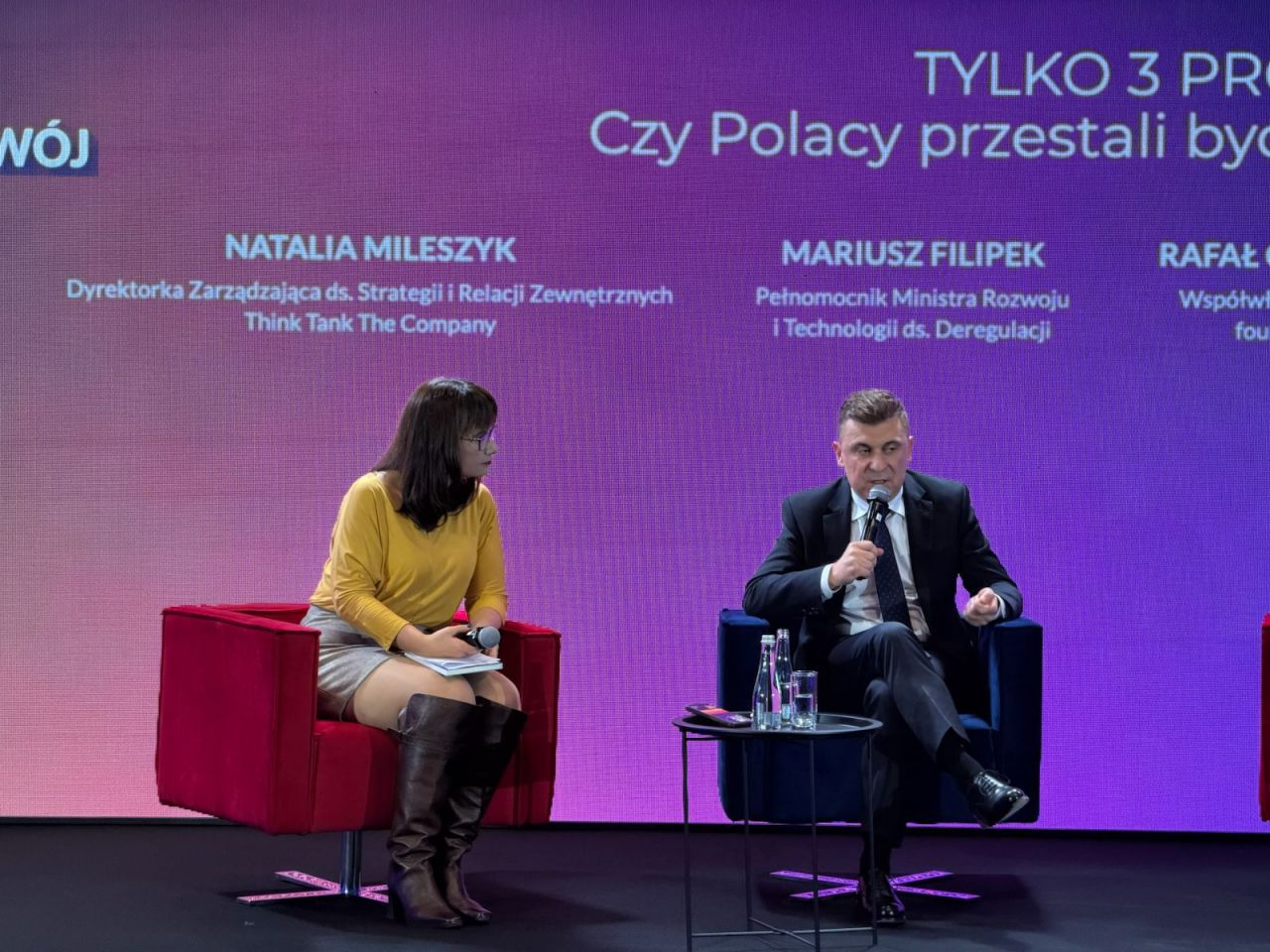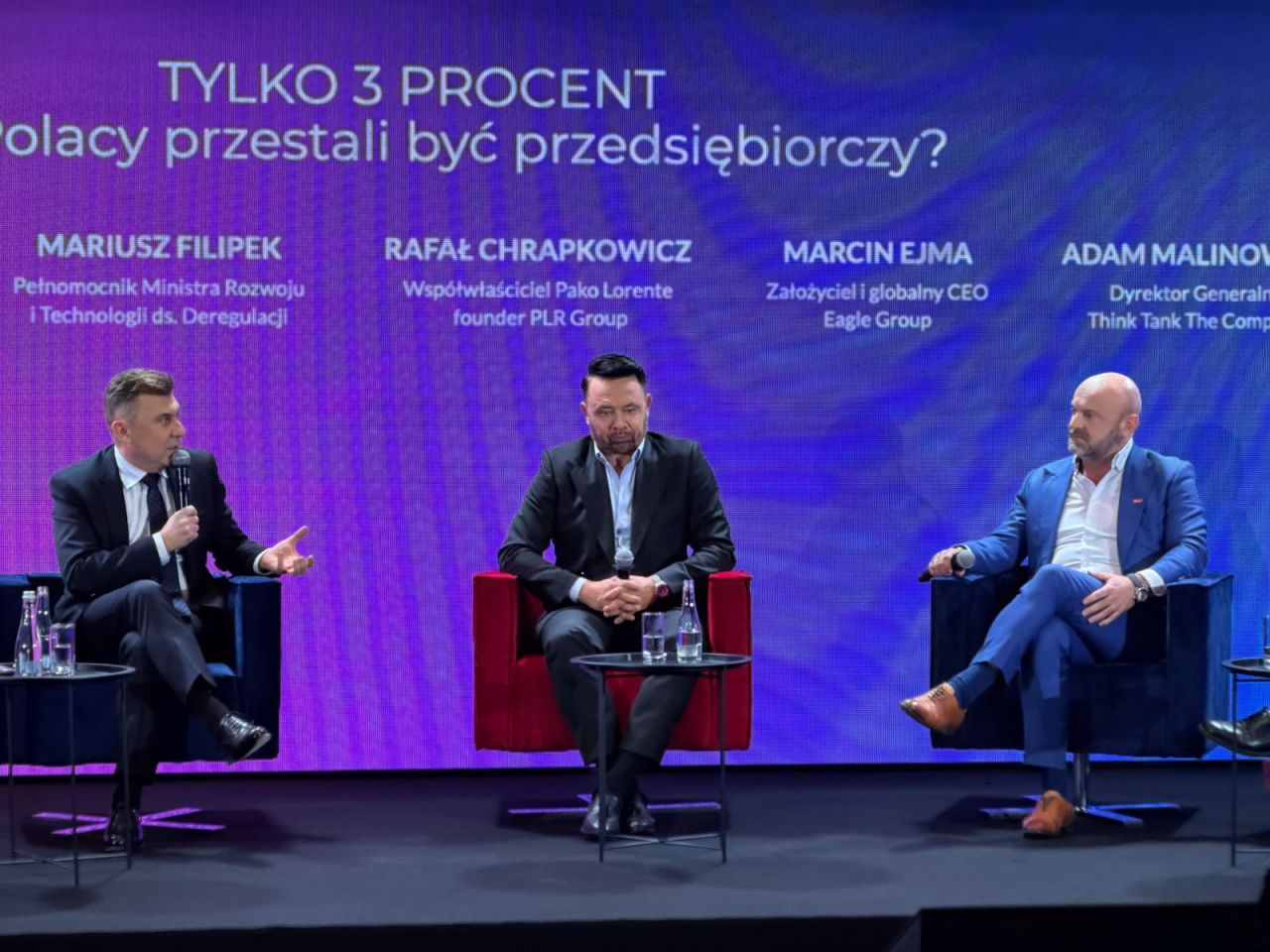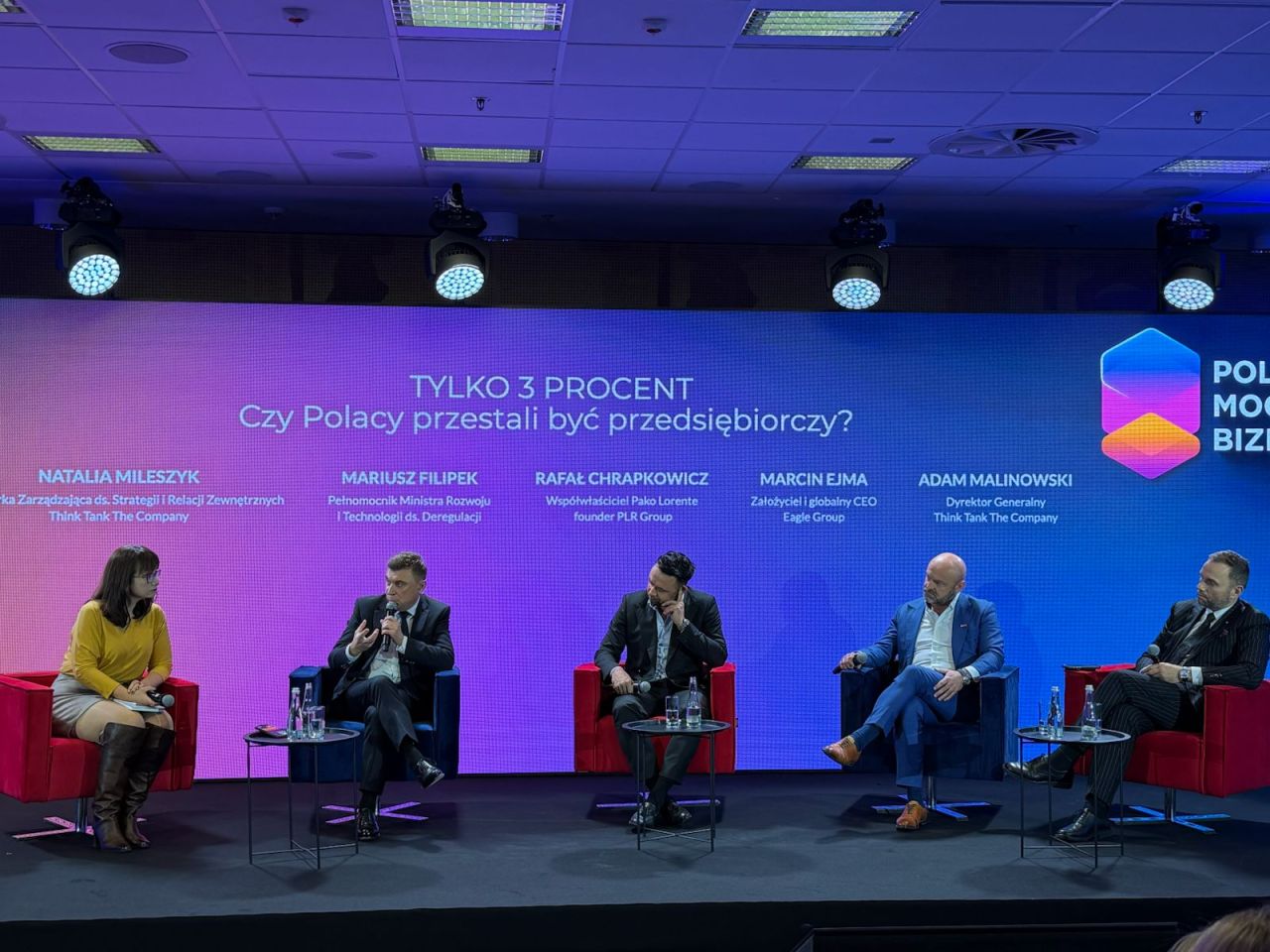
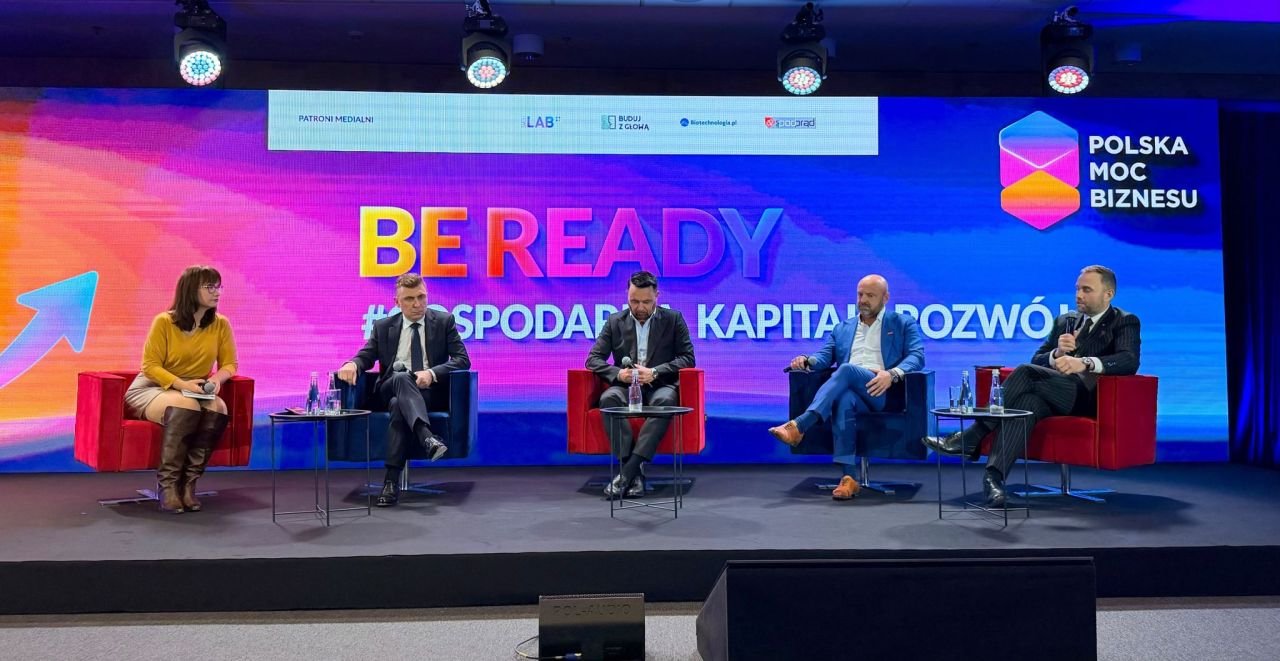
The GEM study result was the starting point for a panel held on 16 November 2026 on BE READY, a stage of the Polska Moc Biznesu event. The panellists looked for the reasons why young people prefer employment over running their own business, and discussed what universities, the state and entrepreneurs themselves can change.
The discussion featured Mariusz Filipek, Plenipotentiary of the Minister of Development and Technology for Deregulation; Marcin Ejma, founder and global CEO of Eagle Group; Rafał Chrapkowicz, co-owner of Pako Lorente and founder of PLR Group; and Adam Malinowski, Director General of Think Tank The Company. The panel was moderated by Natalia Mileszyk, Managing Director for Strategy and External Relations at Think Tank The Company.
No young companies, no innovation
Adam Malinowski began with China, which has gone from copying other countries’ solutions to becoming a leader in research and development. In his view, Europe, which competes with the United States and China, will be weak without strong R&D. For years, new ideas have come from young entrepreneurs ready to take risks, like the founders of Apple, Tesla and Microsoft in their garages.
“If there is no innovation, no risk-taking, Poland will always be a follower,” Malinowski said. This does not mean a crisis overnight, but the G20 position Poland is proud of will gradually pass to countries with a higher level of innovation.
That is why the image of the entrepreneur is one of the three themes Think Tank The Company is working on in 2026. Malinowski illustrated it with a chain of dependencies: artificial intelligence requires energy, energy requires innovation, and innovation requires the small companies that create it. Deregulation, in turn, requires a government that listens to entrepreneurs, not only to voters in employment. At the root of all these issues lies how Poles perceive entrepreneurs and entrepreneurship.
Later in the discussion, Malinowski pointed out that both entrepreneurs on stage had taken their role models from home. “If only 8 percent of Poles are entrepreneurs today, who is supposed to give young people role models?” he asked.
Employment wins in a simple calculation
Marcin Ejma divided potential entrepreneurs into two groups. The first is driven by personality: ambition, a reluctance to work under someone, a desire to build something big. These people will start a company regardless of external conditions.
The larger group starts businesses for economic reasons, because they want to live better than on a salary: buy a house, a car, pay for their children’s education. These people weigh the responsibility, risk and longer working day against how much more they can earn. The Labour Code and anti-mobbing regulations protect employees well, so the difference in reward is small today and many choose employment.
Ejma does not consider this a defeat: “I don’t know if this isn’t what our grandparents and parents fought for — for Poland to be a good and safe place.” He founded Eagle Group 20 years ago, in 2006, and counts himself in the first group. His father was an entrepreneur, so, as he put it, he had no choice.
Mariusz Filipek did a similar calculation. In employment, a young person earns, for example, PLN 10,000 a month for eight hours of work a day, while in their own company they work at least 12 hours, seven days a week. He noted, however, that 3 percent is better than 1 or 0.5 percent, but one has to ask where it comes from.
Universities, local governments and business must work together
Filipek sees the main cause in education. In the past, young people were helped by business incubators and business angels. Today there is public money for starting a business, yet young people still choose employment.
He teaches law at a university himself and admits that higher education teaches how to become a scientist rather than an entrepreneur. In his view, universities need to cooperate with business and employers’ organisations, with initiative on both sides. He added local governments to the equation: a municipality, county or voivodeship with recognisable local companies gains in image, yet local governments still do not appreciate this. Natalia Mileszyk recalled Stanford, where research results quickly reach business.
Rafał Chrapkowicz founded his first company at the age of 19, and his grandfather and father were entrepreneurs before him. He believes the government and business should jointly prepare a strategy: how many entrepreneurs we need and how we want to change Poland. He cautioned that not everyone is suited to running a company, and many people have been put off because they thought it was easy.
Poland today has global companies, know-how, technology, capital, business organisations and think tanks. That is why, in Chrapkowicz’s view, young people should not start from zero, but from where his generation of entrepreneurs is today. They need a platform that gives them capital and support. Mileszyk recalled that 53 percent of Poles believe they are suited to business.
Chrapkowicz gave the example of SGH students who organised a global business camp. Universities from different countries simulate real business crises in it, and the final will take place in Warsaw.
The mid-market trap
Polish companies do better than the EU average during their first three and a half years, but few of them reach ten years and keep growing. Mileszyk asked Ejma what was harder in the history of Eagle Group: starting up or scaling.
Ejma answered: both. At the start there was no money, because machine production and software required large outlays. One machine cost EUR 550,000, so a customer wanted to see a unit that had been working at someone else’s for five years on two shifts. Meanwhile the company had existed for four years and had been producing machines for one, while the customer was committing to it for ten years of service and spare parts.
When scaling, the problems concerned the owners and the board themselves, who had to learn to delegate and share responsibility. Cultural and geographic differences added to this: a salesperson in the United States visits three times fewer customers than one in Poland because of distances, so the sales model had to be recalculated from scratch.
Ejma called Poland’s weakness in scaling the mid-market trap. The country is big enough to build a mid-sized company without going abroad. In Estonia, smaller than Warsaw, start-ups design products for the international market from day one — hence Skype and Bolt. Once a company is mid-sized and operating comfortably, investment in expansion turns out to be large and difficult, which is why the product must be prepared for scaling from the very beginning.
Malinowski added that the competences that allowed a company to come into being are not enough for it to grow. After about three and a half years, entrepreneurs begin to run out of cash for investment, and an innovator usually does not know how to scale. He invoked the concept of the four Ps: to be founded, to survive, to scale, to hand over. Most founders have the competences for one of these stages, which is why Think Tank wants to teach young entrepreneurs the next ones.
Ejma noted that such places are becoming more common. He mentioned Corporate Connections, of which he has been a member for two years, and Think Tank The Company. He values them for being able to talk as equals with people who have more experience or bigger companies.
Deregulation: finish it and write it into the system
According to data cited by Mileszyk, 26 percent of entrepreneurs who closed their business named bureaucracy and taxes as the reason — twice the European Union average. She asked Filipek what entrepreneurs can expect in the 12 months left until the elections.
Filipek recalled the Prime Minister’s speech at the Warsaw Stock Exchange on 10 February 2025 and Rafał Brzoska, who accepted the invitation to cooperate, and then the SprawdzaMY initiative. Instead of numbers, he spoke of a change in approach: such a social contract between entrepreneurs and the state has never happened on this scale before, and the public side now treats business as a partner.
Ejma pointed out that only 6 percent of MPs are entrepreneurs, so it is hard to expect regulations written with companies in mind. “We are not asking for anything more than not to be hindered. We will deliver results and economic growth,” he said.
Malinowski, who has been involved in deregulation from the beginning, called it the best cooperation between business and government in Poland’s history, though he admitted it had the character of a spurt. It was meant to last 100 days and has lasted 18 months. Entrepreneurs submitted 350 proposals, 260 have been implemented, and 90 are still waiting in ministries, the Chancellery of the Prime Minister, the Sejm, the Senate or at the President’s office. Malinowski’s first demand is therefore: finish it.
Prime Minister Donald Tusk had earlier promised two things: a “two deregulations for one new regulation” rule and a person responsible for deregulation in every ministry. Neither has been implemented systemically, and the Polish legal system makes it difficult to transfer the “2 for 1” rule modelled on the United States. Malinowski proposed that standing deregulation in the Polish model be placed under the auspices of the Ministry of Development and Technology. He also noted that deregulation teams in ministries are today postulated by the Confederation party.
“It was a good idea for 2025. We showed it can be done. Now let’s do deregulation more regularly,” he concluded.
Poland in ten years
Finally, Mileszyk asked the panellists how many Poles will want to start a business in 2036 and what each of them will do to make that number grow.
Malinowski warned that without work on innovation, Europe will become a subcontractor to China and the United States. He invoked Mario Draghi’s report: in the last 50 years, not a single company worth more than EUR 100 billion has been created from scratch in Europe, while in the United States six companies worth more than a trillion have been created in that time. In his view, Poland has the competences to become a leader in Europe.
Ejma gave no number, because he does not know what the word “entrepreneur” will mean in ten years. Artificial intelligence will change the labour market, and with it that notion. He hopes Poland will benefit from this, and he is working towards it at Think Tank.
Chrapkowicz is betting on the creativity of young people. In his holding, he wants to support smaller brands that have potential and are on the verge of scaling.
Filipek recalled that the Ministry of Development and Technology’s deregulation package has already introduced the “one in, one out” rule. He would like a “one in, three out” rule, counted in obligations rather than regulations: we introduce one new obligation, we remove three. If in 2037 the law is stable, predictable and simple, in his view there will be more than 10 percent entrepreneurs.
Gallery