As many as 90% of surveyed entrepreneurs believe they have no real influence on law-making, and trust in the government stands at just 1.92 on a five-point scale. 37% would not choose Poland again as a place to run a business. These are the key findings of the „Report on the Condition of Polish Small and Medium-Sized Enterprises 2026”, presented by Think Tank The Company on 30 September.
At the same time, companies are not giving up on growth: they invest, implement artificial intelligence and enter foreign markets. Barriers become particularly visible when a company wants to move to the next stage of development. The SME sector — companies employing up to 249 people — comprises 2.37 million businesses in Poland. They generate 47.2% of GDP and employ nearly 7 million people.
Among the economic priorities for the future government, entrepreneurs point above all to: tax simplification and ZUS reform (83%), deregulation of administrative obligations (71%) and legal stability, including a ban on retroactive law (66%). Further down the list are competitive energy prices (44%), digitalisation of public administration (40%) and labour law reform (35%).
„An entrepreneur by definition takes on risk. They risk their own capital, investment, the decision to hire more people or enter a new market. However, they should not additionally bear the risk arising from the unpredictability of the state. Stability of the rules is one of the fundamental conditions for making bolder business decisions,” says Adam Niedziółka, vice-chairman of the SME Council at Think Tank The Company.
One of the most interesting findings of the report is the relationship between a company's size and the ambitions and sentiment of its owners. After crossing the threshold of around PLN 10 million in annual revenue, entrepreneurs' ambitions and sentiment clearly change. Above this level, companies more often declare readiness to invest, hire and enter foreign markets. In the smallest analysed companies, around 35–40% of respondents expect an improvement in results, compared to almost 80% in the largest ones.
„We too often treat SMEs as a single category. Yet a company with a handful of employees faces completely different problems than an enterprise employing hundreds of people, developing its own distribution and starting to compete abroad. If we want more large private companies in Poland, we need to better understand what happens at this stage of their development,” says Jędrzej Karasek, vice-chairman of the SME Council at Think Tank The Company.
As many as 23% of respondents plan to start foreign expansion within the next 12 months. In this group, 70% of entrepreneurs expect an improvement in their company's results, compared to 44% across the whole sample. Companies planning expansion also make more frequent use of artificial intelligence solutions. In the authors' view, this is one of the arguments for changing the way SME policy is approached: from a focus primarily on the creation and survival of companies towards creating conditions in which enterprises can scale up their operations.
„In Poland we do not have a problem with the number of companies — there are almost 3 million of them. I would rather ask how many of them grow into medium-sized and large companies. Because the real challenge begins when a company wants to grow. Our data show that a significant change begins at around PLN 10 million in revenue: companies become more willing to invest, hire and enter new markets. Economic policy should help companies get through this stage and keep developing,” says Eliza Kruczkowska, Managing Director of Think Tank The Company.
The survey results feed into the ongoing debate on tax changes. In its position of 27 August, Think Tank The Company drew attention to the planned reduction of the revenue limit entitling businesses to the lump-sum tax from the equivalent of EUR 2 million to EUR 250,000. Further thresholds, beyond which tax conditions change significantly, may discourage companies from growing.
„Polish micro, small and medium-sized enterprises have for years remained one of the most important pillars of the national economy. They create jobs, build the innovation potential and competitiveness of Polish companies and significantly influence the pace of economic development. That is why it is so important that decisions on the conditions of doing business are based on reliable knowledge of entrepreneurs' actual needs and experiences. The results of the survey among 620 representatives of the SME sector make it possible to better understand the challenges Polish companies face. As the Ombudsman for Small and Medium-Sized Enterprises, I consistently maintain that effective law and good economic solutions emerge from dialogue with entrepreneurs and are based on credible data,” says Agnieszka Majewska, Ombudsman for Small and Medium-Sized Enterprises.
The „Report on the Condition of Polish Small and Medium-Sized Enterprises 2026” is based on a survey of 620 business owners representing various industries, regions and company sizes. The survey results were compared with data covering the entire SME sector, including PARP and GUS statistics.
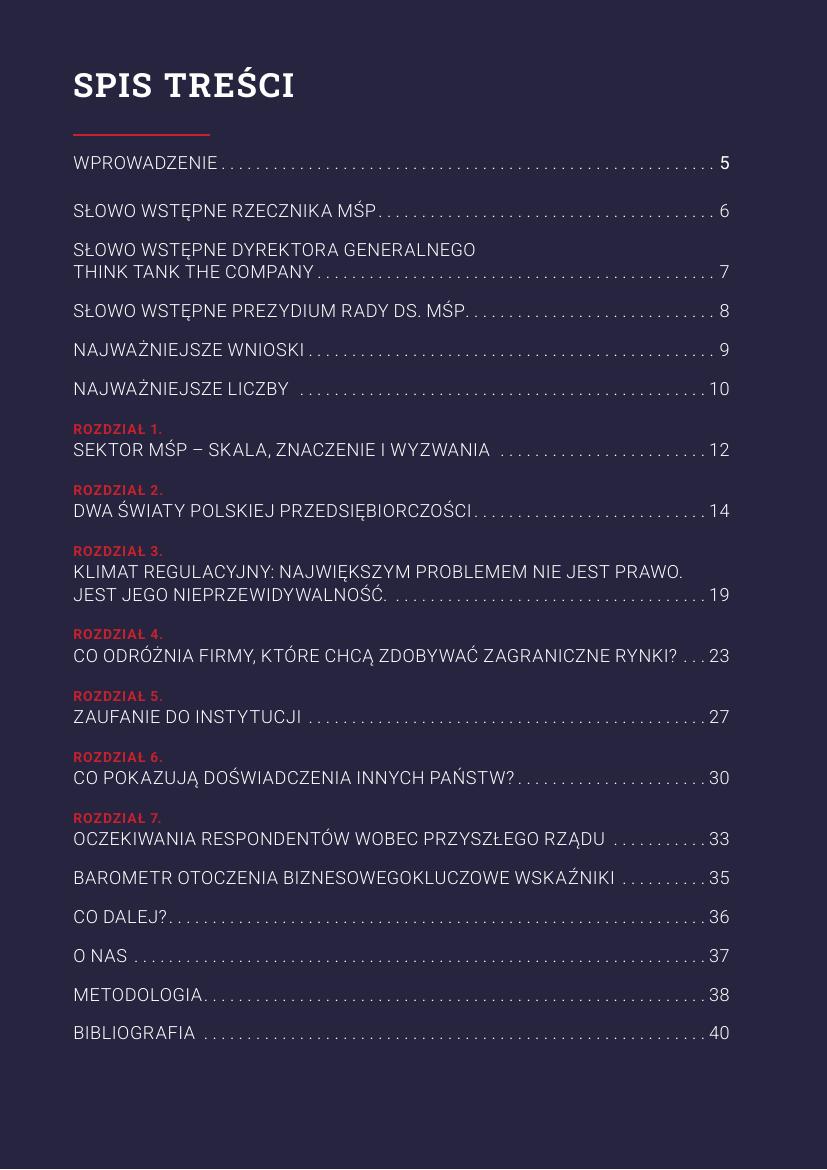
Report preview
Take a look at the first pages of the report before downloading.
Gallery