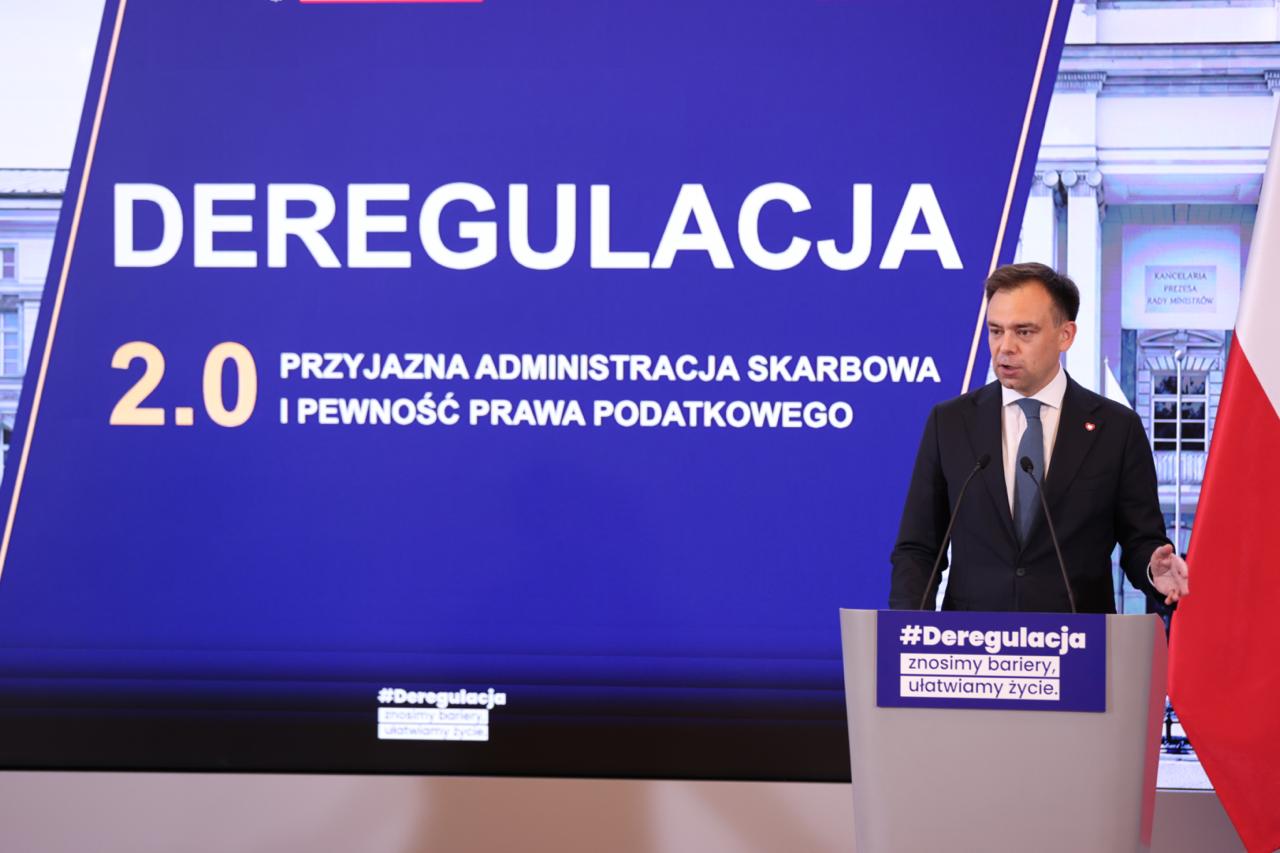
The package of tax law proposals presented during the press conference on 6 July 2026 by Ministers Maciej Berek and Andrzej Domański deserves – in the view of Think Tank The Company – the most positive assessment. Think Tank The Company hereby expresses its full support for the proposals and the hope that they will be adopted by the legislator as swiftly as possible and implemented in full – ideally, given their tax nature and the vacatio legis period, as of 1 January 2027. In our view, this would bring significant benefits to entrepreneurs and to all taxpayers.
The package covers four principal areas (pillars): increasing the certainty of regulations and predictability of tax authorities' actions, simplifying tax proceedings and activities, broad use of the so-called tacit consent mechanism in tax law, and further digitalisation of contacts and activities within the tax administration.
Increasing the certainty of tax regulations and predictability of tax authorities' actions will involve a substantial reform of tax rulings. Notably, tax rulings will be available in a central electronic database, issued for a period of 5 years; during that time the taxpayer will be able to fully rely on their content, even if the underlying legal provisions change. Tax authorities will therefore be responsible for keeping rulings up to date and adjusted to changes in the law, and for periodically reviewing them.
The legislator will also – as Think Tank The Company emphasises – introduce solutions concerning the binding nature of information obtained from tax authorities in the area of both PIT and CIT (a mechanism that works very well for VAT and excise duty), so that acting in line with such a position will eliminate the risk of legal liability of the taxpayer. Acting in trust of the tax authority's position will therefore not carry the risk of negative consequences – one of the foundations of a democratic rule-of-law state.
Similarly, the legislator intends to categorically confirm the prospective nature of general tax rulings, which in no case will be able to act retroactively or imply negative consequences for taxpayers. This protects taxpayers from situations in which a change in the tax authority's position would, for example, require retrospective payment of taxes.
The legislator also intends to introduce – in the view of Think Tank The Company most reasonable – solutions on the uniform interpretation of local tax regulations, so as to eliminate the current situation in which municipal authorities frequently issue extremely divergent interpretations. For local taxes, interpretations will – as is the case with national taxes – be issued at the national level, avoiding cases where different municipalities issue extremely different interpretations for identical facts and legal states.
This group of changes also includes a materiality threshold in tax proceedings: where an unintentional taxpayer error is below the threshold, proceedings will not be initiated at all, and no negative consequences will be drawn against the taxpayer.
Another proposal is that real estate tax will be enforced proportionally to the share in the ownership right. The legislator intends to move away from the current principle of joint and several liability for tax obligations, towards a model where liability is a function of the share in co-ownership, rather than of co-ownership itself.
The above changes will implement postulates arising from the principle of citizen trust in the state and the law – a constitutional element of a democratic rule-of-law state – so that such action will not imply the risk of administrative or fiscal-criminal liability of the taxpayer. Respecting this principle is one of the foundations of a business-friendly state and will certainly make it easier for entrepreneurs to conduct business activity.
As part of the simplification of tax proceedings and activities, the government proposed, first of all, introducing time limits for verification activities carried out by tax authorities, which – unlike inspection activities – are currently not limited in time. Think Tank The Company fully agrees and supports the introduction of such time limits, which will streamline proceedings and increase taxpayers' trust in tax authorities.
The government also proposes that a taxpayer's compliance with the results of verification activities should immunise the taxpayer against fiscal liability and against the accrual of penalty interest.
In this group of proposals, the government also postulates broadening the catalogue of assets on which security for tax obligations may be established, coupled with the taxpayer's ability to indicate such an asset. In particular, tax security should not disorganise the taxpayer's business activity (as is currently the case when security is established on the current bank account). Part of this proposal is also to subject so-called securing decisions to instance and judicial review as to their correctness.
Think Tank The Company likewise positively assesses the proposal that an entity party to restructuring proceedings will be entitled to obtain a certificate of no tax arrears. This will eliminate situations in which such an entity is “excluded”, for instance, from public procurement proceedings due to the lack of such a certificate. Restructuring proceedings, aimed at rehabilitating the financial situation of the entity, will thus be able to be effectively carried out and enable the entity to remain in business.
The legislator also proposes changes to the Tax Ordinance Act. Think Tank The Company fully supports the principle that the tax authority should independently obtain, in explanatory/evidence proceedings, documents held in public registers, in particular those maintained digitally.
Think Tank The Company also assesses very positively the harmonisation of the Tax Ordinance Act with the Code of Administrative Procedure regarding the enforceability of an administrative decision that fully corresponds to the party's request. Such a decision will as a rule be immediately enforceable, and the party will be entitled to waive the right to file ordinary legal remedies against it – which will shorten proceedings and ensure that decisions become final and binding more quickly.
Think Tank The Company fully supports extending the deadline for lodging an ordinary legal remedy against a first-instance administrative decision under the Tax Ordinance Act from the current 14 days to 30 days. This longer deadline – given the formalised nature of appeals under the Tax Ordinance Act – will, in our view, better protect the rights and interests of taxpayers.
The group also includes the proposal to reduce late-payment interest by 50% in situations where the taxpayer notices the error themselves and corrects the return, or files the first return late while simultaneously paying the tax due.
The proposed changes will – in our view – significantly streamline tax proceedings and contribute to building a relationship of trust between the taxpayer and tax authorities.
The third pillar of SprawdzaMY 2.0 concerns the tacit consent mechanism, where the legislator intends to significantly broaden its use in tax matters. The mechanism will apply both to substantive and procedural law issues. It is worth emphasising that the legislator intends to introduce tacit consent also under the Tax Ordinance regime, for procedural decisions issued by tax authorities (such as the restoration of a missed deadline). Broad use of tacit consent will clearly result in tax cases being resolved significantly faster.
The fourth and final pillar of SprawdzaMY 2.0 concerns digitalisation, with proposals such as the pre-filling of VAT returns. Following the model adopted for PIT, a VAT return pre-filled with data drawn from tax systems such as KSEF will be available on the e-podatki portal, with the taxpayer's role being to approve or correct it.
This group of changes also includes an application – completely free of charge and prepared by the tax administration – that will enable the use of any mobile device as a fiscal cash register and the issuing of so-called e-receipts, as well as their receipt by the entrepreneur's clients.
In the view of Think Tank The Company, these digital changes, based on the use of digital data at the disposal of tax authorities, will on the one hand lead to further tightening of the tax system, and on the other to relieving the taxpayer, as the burden of activities will shift to the tax authorities' IT systems. This will, of course, also be linked to a significant reduction in the taxpayer's operating costs.
Think Tank The Company assesses the proposed changes most positively and fully supports them. These changes will – it seems – shift the model of the relationship between taxpayers and tax authorities; the latter will trust taxpayers to a greater extent than under the current legal state, and taxpayers will be able to act in trust of tax authorities and their positions.
Think Tank The Company also notes that these changes will – as it seems – be positively received by entrepreneurs, for whom the attractiveness of the tax system is one of the key factors determining investment attractiveness.
Think Tank The Company hereby expresses the hope that the proposed changes will be adopted by the legislator as swiftly as possible, and that already from 1 January 2027 they will be implemented in the practice of economic activity.
Finally, Think Tank The Company indicates that throughout the legislative process it will support the presented proposals and will provide expert advice to the government.
Gallery