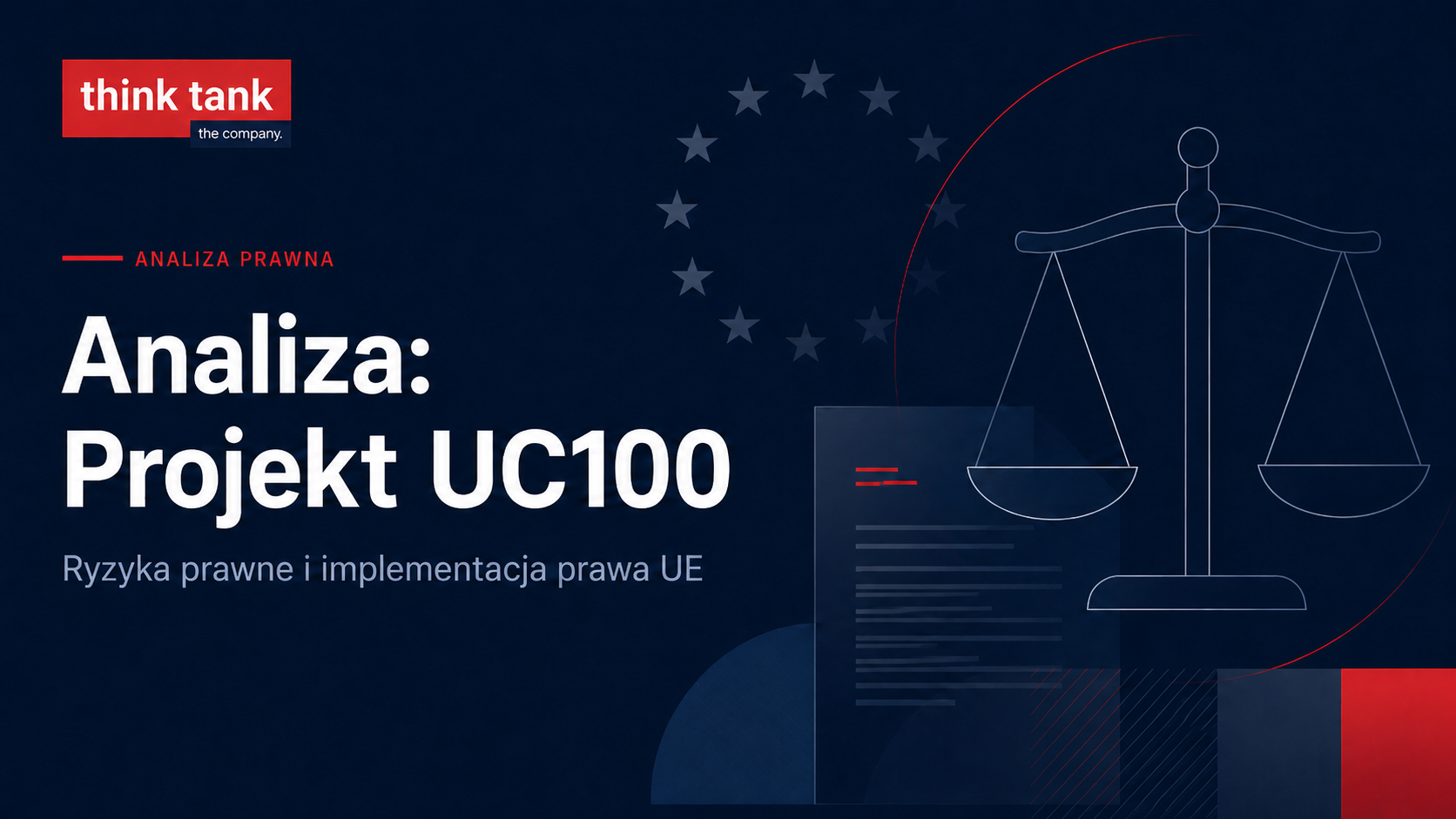
Warsaw, 9 July 2026 – The draft act on packaging and packaging waste (UC100) requires further analysis before the legislative process is concluded. According to the latest paper from Think Tank The Company, the proposed extended producer responsibility (EPR) model may create serious legal risks related to the implementation of Directive 2008/98/EC and lead to a solution that has no equivalent in any EU member state.
The analysis has been submitted to the Ministry of Climate and Environment as an expert voice in the ongoing legislative work. The document focuses on the compliance of the UC100 draft with EU law and points out that the proposed transfer of EPR Organisation competences to the National Fund for Environmental Protection and Water Management may raise significant legal doubts. In the authors' view, the issue is not the choice of the organisational model itself, but the way it has been designed and its compatibility with the applicable EU rules.
The report notes that under current regulations member states have discretion in choosing the EPR system model, yet the solutions adopted in the UC100 draft depart significantly from EU practice. The authors emphasise that no member state has been identified in which the tasks of a producer responsibility organisation would be performed by a public administration body that is not an undertaking. In the experts' view, this may hinder the fulfilment of obligations arising from Articles 8 and 8a of Directive 2008/98/EC and create a risk of improper implementation of European law.
The Think Tank The Company publication is part of a broader debate on the UC100 draft. In recent weeks, the Institute of Public Finance published an analysis of the economic consequences of the proposed reform, pointing among other things to a possible significant increase in system operating costs, their transfer to entrepreneurs and consumers, and the lower efficiency of centralised models compared to the competitive solutions used in most EU countries. The legal analysis by Think Tank The Company therefore complements earlier studies with the perspective of the draft's compliance with European law.
„Discussion of the UC100 draft has so far focused above all on the economic effects of the proposed solutions. Our analysis shows that legal questions are equally important. Implementation of the directive must not result in a model that raises doubts as to its compatibility with EU law and has no equivalents in other member states. It is in the interest of the state, entrepreneurs and consumers to adopt durable solutions that are lawful and resilient to future interpretative disputes,” says Prof. Paweł Wajda, director of the policy hub at Think Tank The Company.
„The discussion on UC100 should not be a contest over who is right, but a test of the maturity of the market, the administration and experts. Poland has a chance today to build an EPR model compliant with EU law, economically feasible and based on the experience of a mature market. The role of Think Tank The Company is to strengthen dialogue and organise the arguments in the interest of the Polish economy,” says Bartłomiej Hajduk, Fundacja Odzyskaj Środowisko.
The authors emphasise that the aim of the analysis is not to question the very idea of extended producer responsibility. On the contrary — they point out that Poland has been lagging for several years in implementing EU EPR rules and that the reform is necessary. In their view, however, it should be based on solutions compliant with European law, ensuring transparency of the system, regulatory predictability and effective delivery of environmental objectives.
Think Tank The Company appeals for the presented comments to be taken into account before the legislative process is concluded and declares its readiness to continue participating in expert work on developing an EPR model that meets both EU legal requirements and the needs of the Polish economy.
Key conclusions of the analysis: the UC100 draft raises significant doubts as to compliance with Directive 2008/98/EC; the proposed organisational model has no equivalent in EU member states; the legal analysis complements earlier studies on the economic effects of the reform; the EPR reform is needed but requires corrections before the legislative process is concluded.
The full report is available at: https://thinktanktc.org/raporty/uc100-rozszerzona-odpowiedzialnosc-producenta
Gallery