
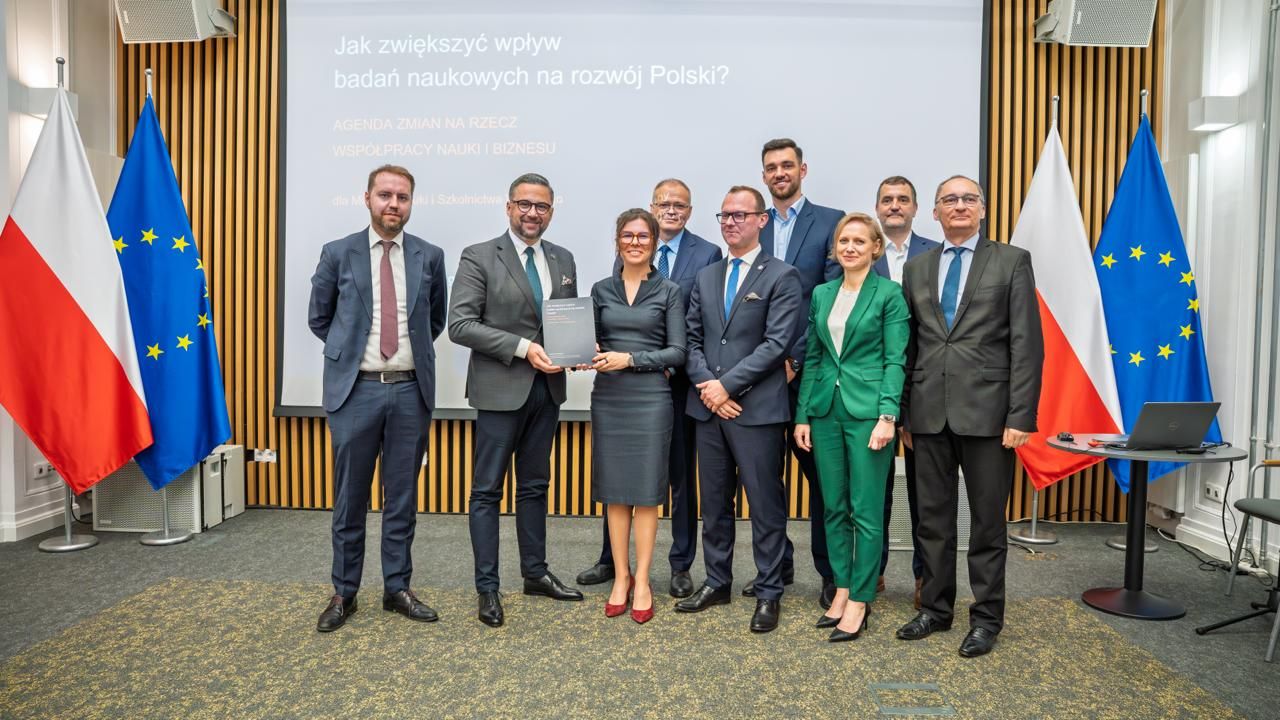
Think Tank The Company supported the work of the Team for Strengthening the Transfer of Research Results at the Ministry of Science and Higher Education. On 12 May 2026, at the Ministry's headquarters on Wspólna Street in Warsaw, recommendations resulting from a year of work by experts from science, business and technology transfer were presented. How can the impact of scientific research on Poland's development be increased?
Nine recommendations, three pillars, one agenda. The result of the Team's year-long work is a concrete agenda for change. As the authors emphasized, the goal was not to reinvent the wheel, but to operationalize what the scientific and business communities have been pointing to for years as necessary changes. The result is a concrete agenda: nine systemic recommendations divided into three pillars and three cross-ministerial initiatives.
The first pillar concerns the readiness of the academic community to translate knowledge into social and economic value. The second covers the system of transferring knowledge and technology to the economy. The third focuses on integrating the research process with implementation – from scientific results all the way to market. Cross-ministerial initiatives include reorienting fragmented funding streams into a coherent cycle from research to implementation, building a center of excellence concentrating research talent, and an incubation and seed investment mechanism for spin-offs.
The proposal for a prestige system for scientists building socio-economic impact – tentatively named Science Impact Poland – deserves special attention. It responds to a real problem: scientists who choose the business path drop out of the science system and become invisible. Mechanisms are needed to ensure that knowledge transfer is recognized as value, not treated as a departure from scientific excellence.
Think Tank The Company accompanied the team's work as the voice of the business community – those who deal daily with the consequences (or lack) of effective knowledge transfer from universities to companies. Polish technology companies are being acquired by foreign capital before they can grow. The best projects mature abroad, because that is where capital, infrastructure and risk appetite are. Poland loses intellectual property, talent and future tax revenues.
„As a country we have enormous intellectual capital in young, talented people who represent a huge opportunity for cooperation between science and business. Poland needs an ecosystem today that not only finances research but also facilitates the creation of startups and the implementation of innovations. This is a chance for Poland to maintain its growth pace and become an economic leader in Europe, and perhaps in the world,” says Dr. Małgorzata Adamkiewicz, representative of the Business Council of Think Tank The Company.
„Polish science has potential that still does not work for the Polish economy to the extent it should. This is not an academic problem – it is a strategic one. Companies need partners from universities, and universities need signals from the market. Without building this bridge, we will keep losing our best ideas to economies that learned this lesson before us,” says Tomasz Misiak, member of the Business Council of Think Tank The Company.
„Poland has for years produced good diagnoses and weak implementations. These recommendations are concrete and operational, which is rare. You can feel the voice of practitioners in them. But knowledge transfer will not happen on its own: equally concrete actions are needed on the side of business, agencies and ministries. That is why it is time to stop asking whether and start asking when and how,” adds Eliza Kruczkowska, Managing Director of Think Tank The Company.
Think Tank The Company identifies three areas critical to the program's success. First: demand matters – transfer cannot be built solely from the supply side of universities and institutes; companies capable of absorbing and implementing technology are needed, along with support for enterprises investing in R&D, regulatory sandboxes, and public procurement that rewards innovation. Second: intellectual property valuation is not a barrier but a competence – moving from a model of large upfront fees to one based on patent protection costs requires building competence on both sides. Third: dialogue between agencies and ministries is essential – establishing an inter-ministerial group coordinating the actions of NCN, NCBR, NAWA and other agencies is one of the most important postulates of the report.
The report was submitted to the Minister of Science and Higher Education, Marcin Kulasek. Minister Małgorzata Młyńska announced that part of the recommendations – in particular changing the evaluation model to take commercialization into account – is already being implemented. The impact of commercialization and research services on evaluation results is expected to grow from about 9% to about 30%. Think Tank The Company will monitor implementation progress and integrate this agenda into broader advocacy work, both within the SME Council and in contacts with European institutions, including the European Innovation Council.